Research
An environment-aware PUF key generator for post-quantum cryptography
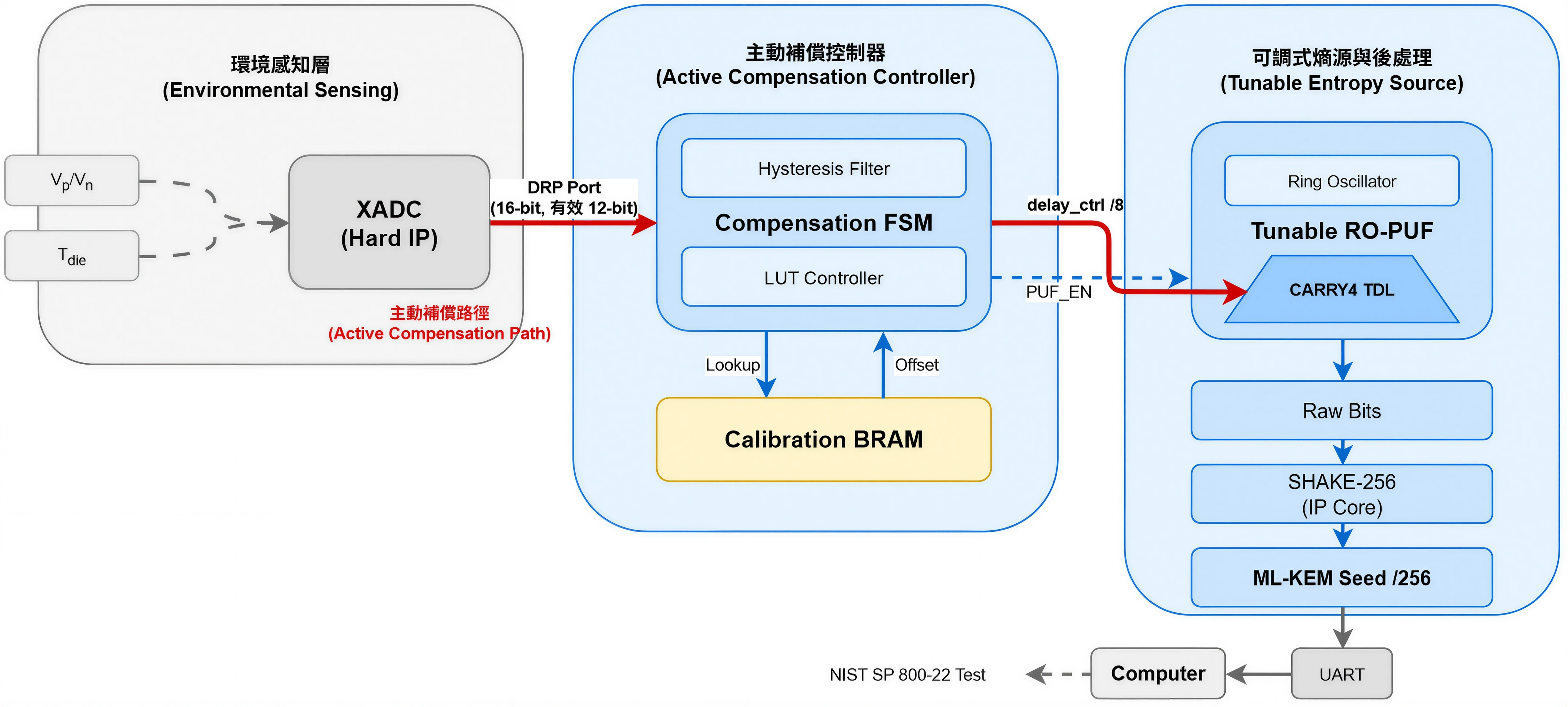
PUFs let a chip avoid storing private keys in memory, which makes them a natural root of trust for post-quantum cryptography. Ring-oscillator PUFs on FPGAs, however, drift with temperature and voltage, and the usual fix, a BCH error-correcting code, eats logic. This work senses die temperature and voltage with the on-chip XADC and compensates through a carry-chain delay line, so a lightweight repetition code can replace BCH; SHAKE-256 then derives the 512-bit ML-KEM seed.
01
How a key grows out of the chip
When temperature or voltage moves, a lookup table retunes the delay line so the PUF's fingerprint stays stable; SHAKE-256 then derives the ML-KEM seed.
← Swipe to see the whole flow →
Undergraduate research
Implementation and measurements
Verilog on a Nexys A7-100T; figures from the research progress report.
- mean Hamming distance on stable bits (31-vote enrollment + unstable-pair mask)
- 0.03 / 128
- mean Hamming distance on stable bits (31-vote enrollment + unstable-pair mask)
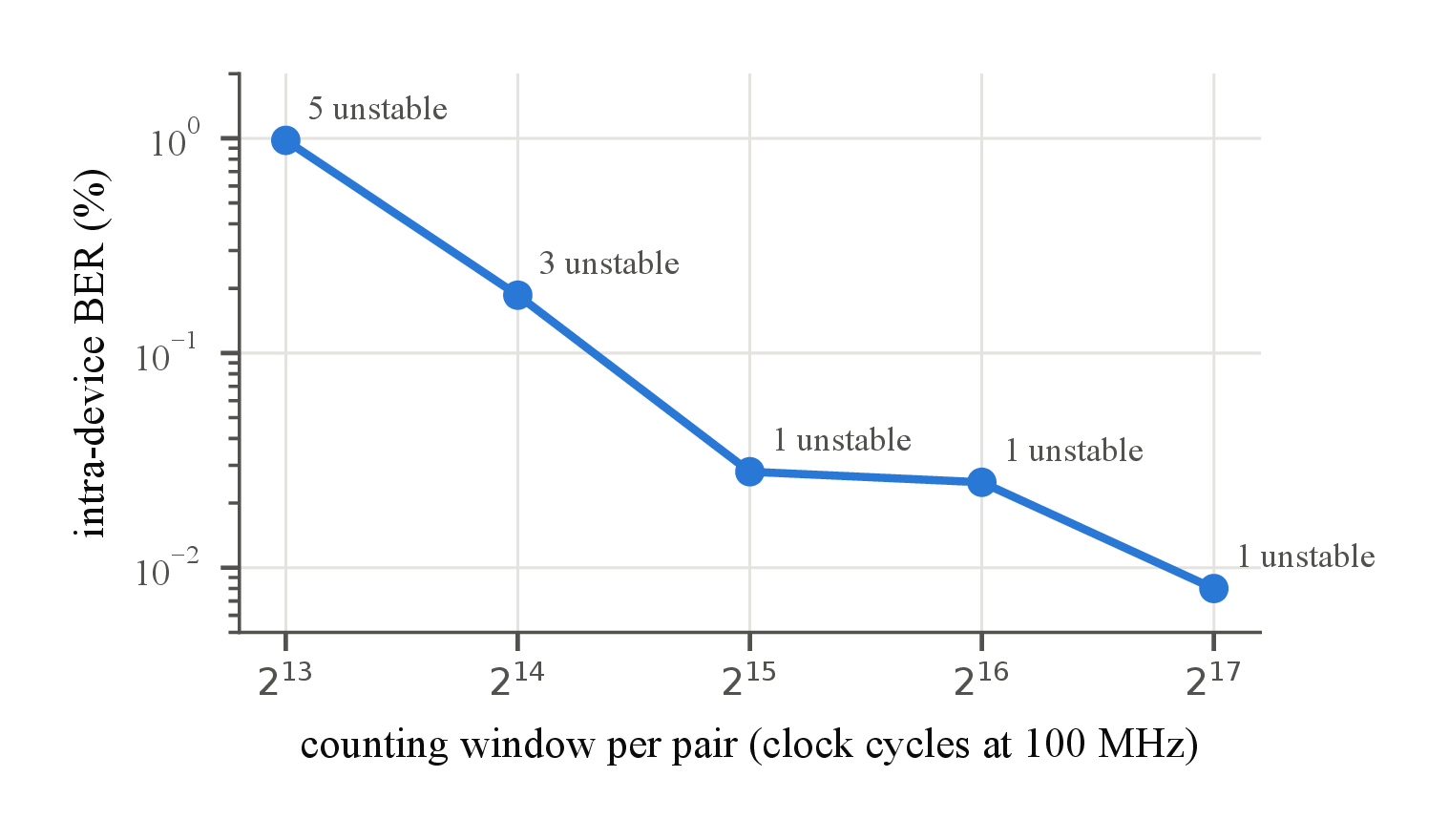
- bit-error rate (2¹⁷-cycle counting window)
- 0.008%
- bit-error rate (2¹⁷-cycle counting window)
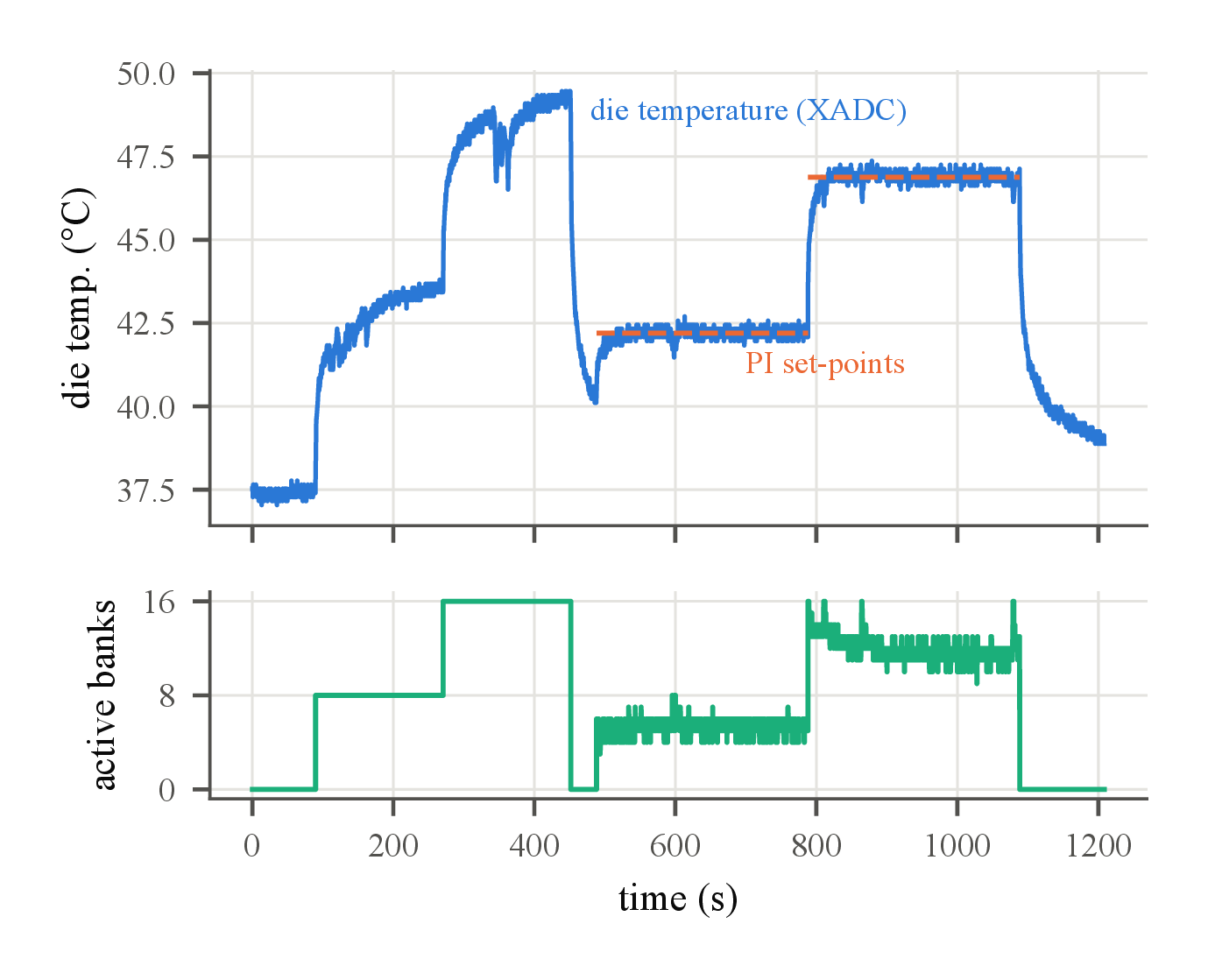
- keys reproduced across a 40–50 °C heater sweep
- 250 / 250
- keys reproduced across a 40–50 °C heater sweep
- LUTs vs a BCH(127,64) decoder at 128 pairs (−58.7% at 254 pairs)
- −70.5%
- LUTs vs a BCH(127,64) decoder at 128 pairs (−58.7% at 254 pairs)
- NIST SP 800-22 tests passed by the TRNG output
- 15 / 15
- NIST SP 800-22 tests passed by the TRNG output
NSTC undergraduate grant
Research proposal
Design of a High-Stability PUF-Based Post-Quantum Key Generation System Based on FPGA XADC Environmental Sensing Mechanism
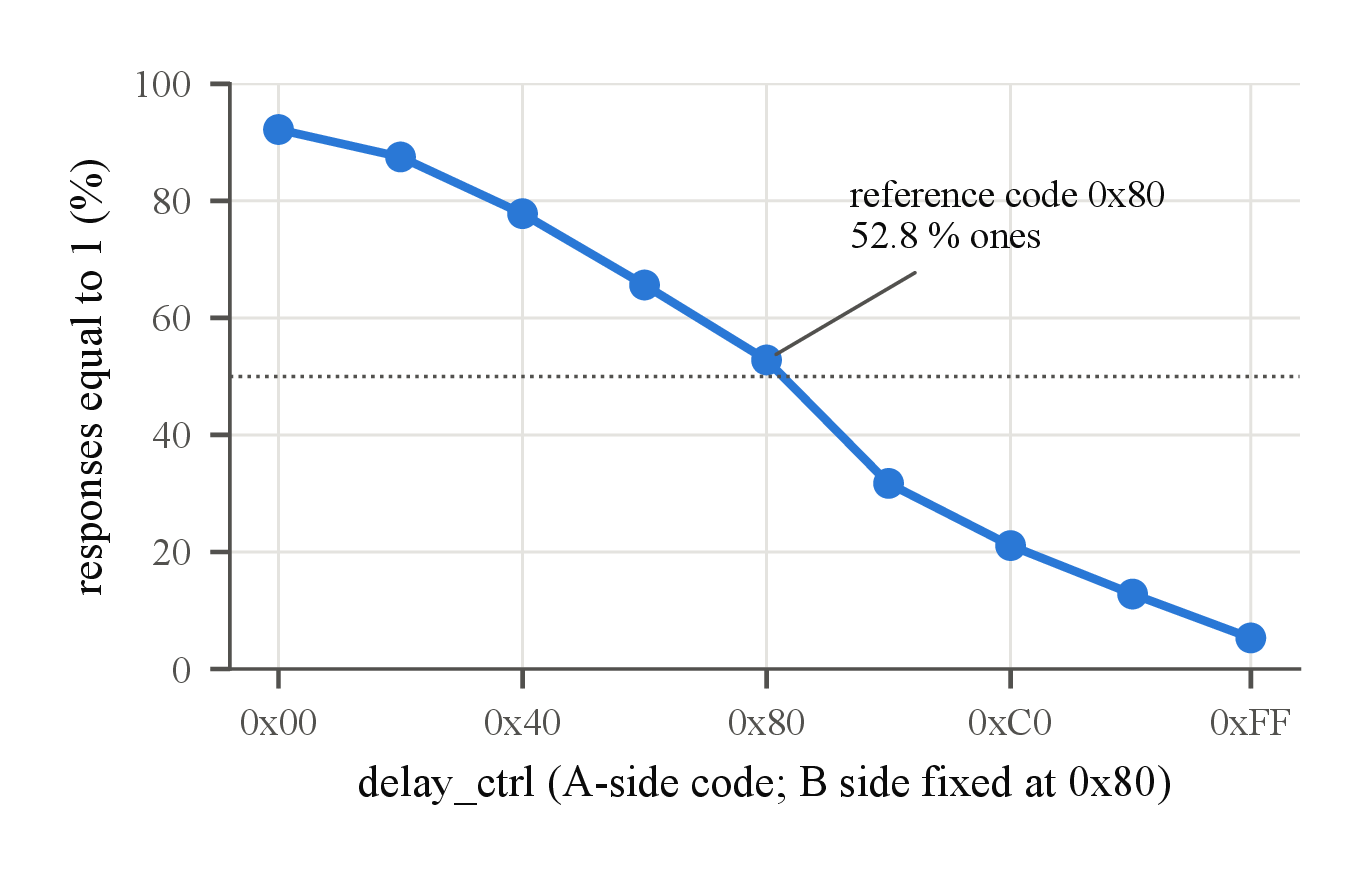
- 01Step 1Tunable RO-PUF on CARRY4
- 02Step 2Build the D_opt = f(T, V) table
- 03Step 3XADC DRP + FSM + hysteresis
- 04Step 4SHAKE-256 → ML-KEM seed, LUTs vs BCH
Proposal targets
- Bit-error rate from above 5% to below 3%
- At least 30% fewer slice LUTs than PUF + BCH(127,64)
- Pass all 15 NIST SP 800-22 tests
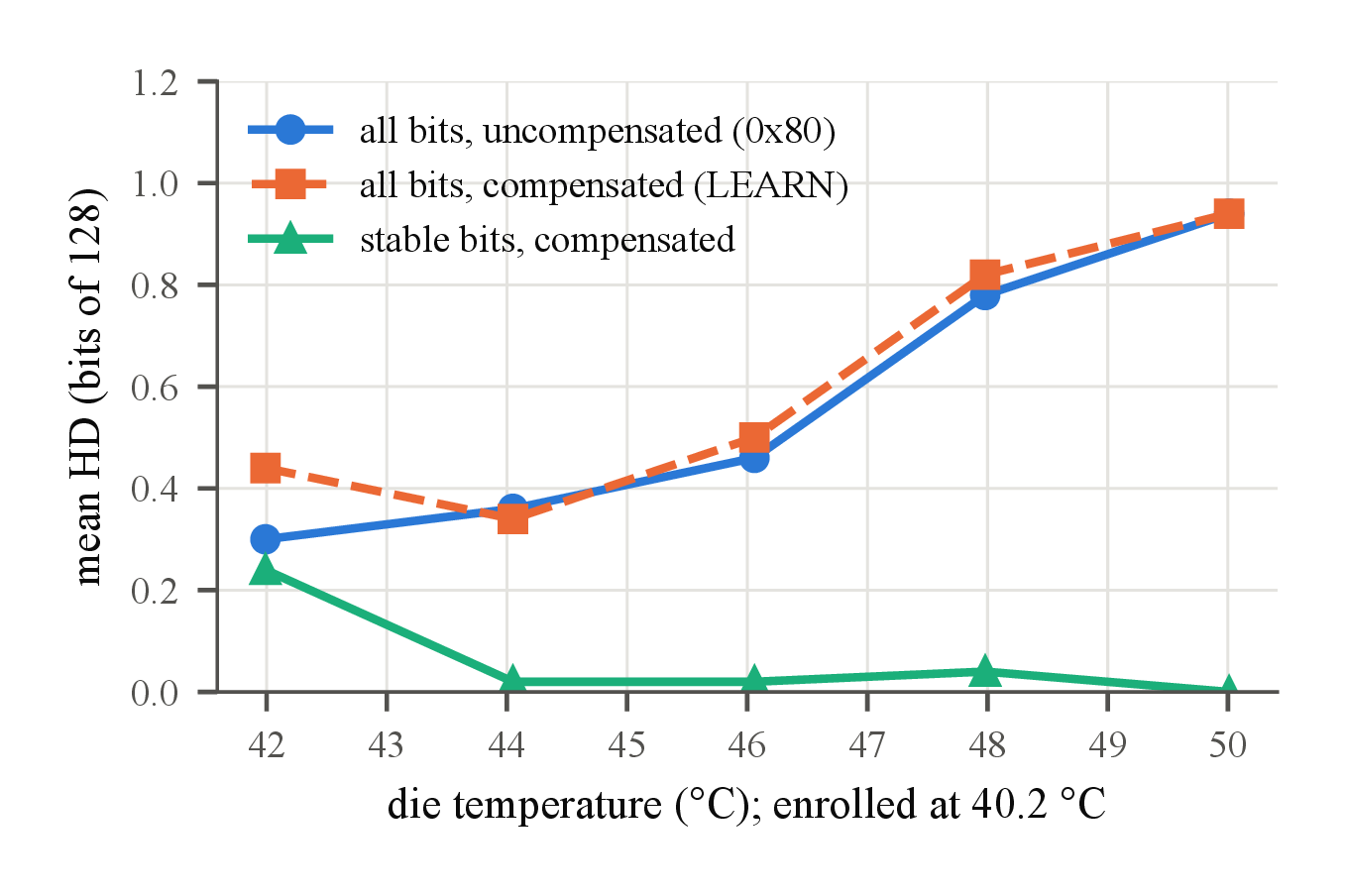
Current limitations
- The on-chip heater's range is too narrow to exercise the compensation.
- The carry-chain RO limits the array to roughly 250–380 pairs on this device.
- Vivado cannot lock RO routing across rebuilds.
Next steps
- 01Chamber tests over 20–75 °C to quantify the compensation
- 02SP 800-90B evaluation of the raw entropy source
- 03Integrate an ML-KEM core and verify with FIPS 203 vectors
- 04A smaller RO cell to reach the 256-bit entropy budget
- 05Uniqueness measurements across multiple boards